
Choosing the right mutual fund does not start with picking a brand or chasing last year’s returns. It starts with one simple question: what is this money meant for? Your goal, time horizon, and comfort with ups and downs should decide the category of fund you choose.
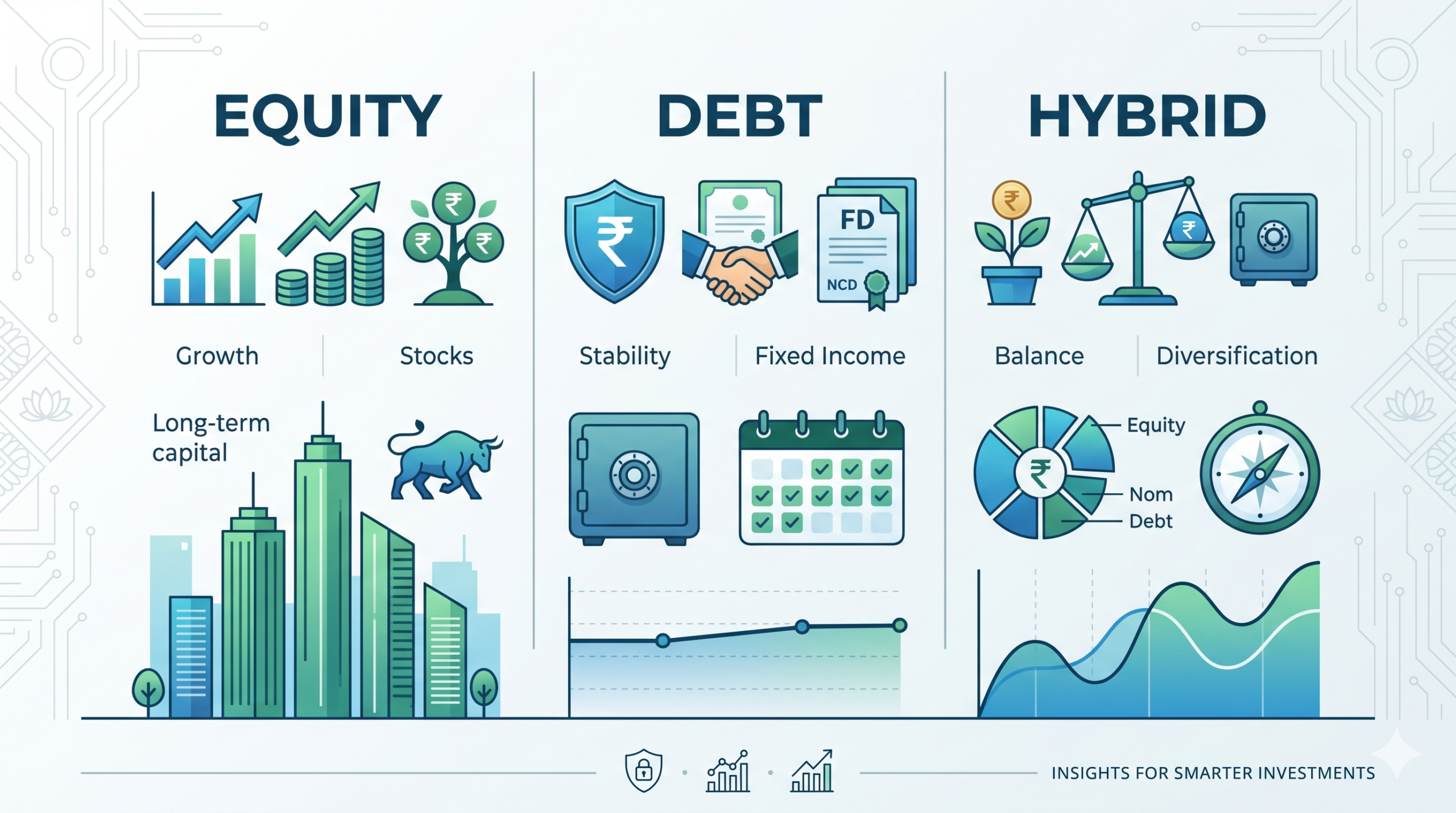
Mutual funds are generally grouped into equity, debt, and hybrid categories. AMFI’s investor education material explains that mutual funds pool money from many investors and invest according to a defined objective, while AMFI’s categorization guidance outlines how different categories suit different needs and risk profiles.
Equity funds
Equity funds invest primarily in shares of companies. They are designed for long-term wealth creation, but they also come with short-term volatility.
These funds are suitable when:
- Your goal is at least 5 years away.
- You can tolerate market fluctuations.
- You want growth, not stability alone.
Examples of goals:
- Retirement
- Child education 10 to 15 years away
- Long-term wealth building
Equity funds can deliver stronger long-term growth potential, but they do not move in a straight line. In one year they may disappoint, and in another year they may outperform sharply. That is why equity works best when time is on your side.
Debt funds
Debt funds invest in fixed-income instruments such as bonds, treasury bills, and money market securities. Their role is usually capital preservation, lower volatility, and more predictable behavior compared with equity-heavy funds.
These funds are suitable when:
- Your goal is short- to medium-term.
- You want lower volatility.
- You need a parking space for money with relatively better flexibility than traditional idle savings.
Examples of goals:
- Emergency reserve layering
- Near-term purchase in 1 to 3 years
- Temporary allocation before phased deployment
Debt funds are not “risk free,” but they are generally used for stability rather than aggressive growth.
Hybrid funds
Hybrid funds combine equity and debt in one scheme. AMFI’s categorization notes that debt-oriented hybrid funds may suit conservative investors seeking a modest return boost with limited equity exposure, while other hybrid categories can provide different risk-return combinations.
These funds are suitable when:
- You want a middle path.
- You are a first-time investor.
- You have moderate risk tolerance.
- You want easier asset allocation in one product.
Examples of goals:
- Medium-term family goals
- First-time mutual fund investing
- Investors who panic during sharp equity corrections
Hybrid funds can be a practical stepping stone for new investors because they reduce the all-or-nothing pressure of choosing only equity or only debt.
How to choose correctly
Use this simple framework:
- Goal under 3 years: Debt-oriented approach may fit better.
- Goal 3 to 5 years: Conservative hybrid or balanced approach may make sense.
- Goal above 5 years: Equity or equity-oriented hybrid may be considered depending on your comfort level.
Also ask yourself:
- Will I stay invested during a market fall?
- Do I need this money on a fixed date?
- Is stability more important than high return potential?
A good fund category is one you can stick with, not one that only looks exciting in a return chart.
Common mistake
The biggest mistake is using the same fund type for every goal. Money for retirement and money for a down payment next year should not usually be treated the same way. Goal-based investing works better because it matches the fund category to the job that money has to do.
Closing note
There is no “best” category for everyone. Equity is not always right, debt is not always safe enough for every expectation, and hybrid is not automatically superior. The right choice depends on your timeline, goal, and behavior as an investor.